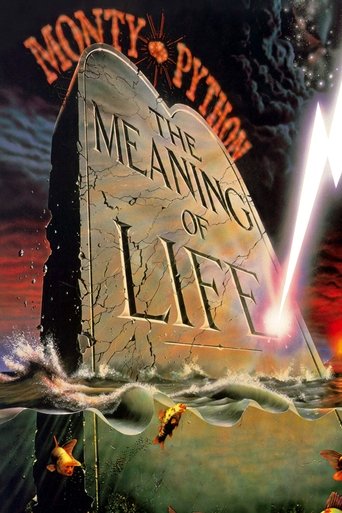
Monty Python's The Meaning of Life (1983) Review: A Glorious, Unflinching 10/10 Finale If Holy Grail was a medieval romp and Life of Brian a pointed satire, then The Meaning of Life is Monty Python's grand, chaotic, and philosophically unhinged thesis statement. It is their most ambitious, most visually stunning, and most brazenly offensive film — a series of sketches loosely tied to the seven ages of man that asks the biggest question of all and answers it with a song-and-dance number, a torrent of vomit, and a talking fish. It is, in short, a perfect 10/10 and the most Python-esque film they ever made.
The Main Feature: From Birth to Death and Everything Absurd
The film is a return to their sketch-show roots, but with a Hollywood-sized budget and a directorial confidence from Terry Jones that allows each segment to be a self-contained masterpiece of style and substance. The tone swings wildly from musical extravaganza to bleak existential horror, often within the same scene, and it is this fearless commitment to the bit that makes it so brilliant.
Highlights of a Universe of Genius:
The Miracle of Birth (and the Machine that Goes 'Ping!'): The film opens with one of its most legendary sketches. In a sterile, futuristic hospital, a husband is ushered into a delivery room that resembles a factory floor. The doctors are more concerned with the hospital's expensive, state-of-the-art machine that goes "Ping!"—the only machine whose purpose is to be turned on to signify how well-equipped the hospital is — than with the actual mother giving birth. When the baby is finally born and the father asks, "Is it a boy or a girl?", the doctor's dismissive, politically ahead-of-its-time reply; "I think it's a little soon to start imposing gender roles on it, don't you?" — is a sublime piece of satire that lampoons both cold medical bureaucracy and emerging social trends in one flawless line.
The Universe in a Fish Tank: The "Live Organ Transplants" sketch, where a platoon of doctors invade a man's home to repossess his liver, is a masterpiece of escalating horror-comedy. The "Middle of the Film" segment, where a grotesquely obese Mr. Creosote is persuaded to eat "one last wafer-thin mint," is a Rabelaisian spectacle of excess. And the film's philosophical core, "The Galaxy Song," is one of Eric Idle's most beautiful and humbling compositions, reminding us of our tiny, insignificant place in a vast cosmos—set to a cheerful calypso tune.
The Short Before the Feature: The Crimson Permanent Assurance
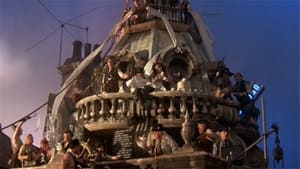
Attached to the beginning of the film is what is essentially a 15-minute Python movie in its own right: "The Crimson Permanent Assurance." Directed by Terry Gilliam, this is not a sketch; it is a breathtaking epic of high-seas rebellion. It tells the story of a group of elderly accountants who, fed up with their corporate "The Very Big Corporation of America" overlords, convert their entire office building into a pirate ship and sail the financial districts of the world, plundering other skyscrapers.
It is a stunning piece of filmmaking—a swashbuckling allegory for creative freedom, geriatric rage, and the fight against soulless modernity. While tonally different from the main feature, its themes of rebellion against a meaningless, corporate existence perfectly set the stage for the existential inquiry to come.
The Verdict: A Fittingly Absurd Final Bow
10 out of 10 - The Pythons' Magnum Opus
The Meaning of Life is the pure, uncut essence of Monty Python. It is their most philosophically coherent work, arguing that life is a bizarre, often cruel, and ultimately meaningless parade, and that the only sane response is to find the humour in the grotesque and the sublime. It is more fragmented than their previous films, but that is its strength — it is a kaleidoscope of human existence, from the ridiculousness of birth to the terrifying finality of death, all treated with the same irreverent glee.
It is the most expensive machine in the hospital, the one that goes "Ping!" — flashy, seemingly pointless, but an undeniable marvel of engineering. And in its final moments, when Eric Idle returns to sing the film's answer to the ultimate question, it delivers a conclusion that is as profound as it is silly, cementing its status as the boldest and most brilliant farewell a comedy troupe could ever give.